
How to Make a Decision: The Art of Saying No and Many Other Decision-Making Tools
If you’re wondering how to make a decision then you are in the right place. This article will teach you how to make a decision through the art of saying know. Decisions can be difficult. What are the important factors to consider? What if I make the wrong decision? Using tools like the Eisenhower Matrix, decision trees, and simple pros and cons, you will know exactly how to make a decision.
Whether you are facing a potential career change, deciding what school to go to, or have a challenging personal dilemma, knowing how to make a decision can be a valuable skill. Unfortunately, most of us get stuck with analysis paralysis and feel lost. You are not alone. In fact, I am currently facing a tough career decision (more on that later).
This article will teach you exactly how to make your decision, but let’s first discuss why it’s so important to make a good decision.
Why Making Good Decisions is Important
Decisions are the life blood of the outcome of our lives. If you can make good decisions you’ll have a good life. The greatest entrepreneurs, educators, investors, and leaders are all good decision makers. They aren’t perfect decision makers. Everyone is human after all.
Good decisions lead to good outcomes, whether that is fighting the right battle, empowering a country, gaining a high return on your investment, or growing your business. One good decision can change many people’s lives.
However, because of human error, many great leaders have created systems for making decisions, whether it was an internal system or an external system, all great decision makers had a process to consistently make great decisions. We are no different, but fortunately we don’t need to create our own systems because they already built great decision-making tools for us (like the Eisenhower Matrix).

What are Decision-Making Tools
Decision-making tools are processes, tangible or intangible, that help us find the optimal decision based on a desired outcome. For example, a pros and cons list allow us to compare decisions and evaluate those decisions so that we can make an informed choice.
Decision-making tools attempt to take our biases out of the decision-making process by creating tangible valuations of specific variables. If that sounds too wordy, it basically means that they make comparing decisions easier, and therefore, make decision making simpler.
What are Common Decision-Making Tools
By far the most popular decision-making tools are the pros and cons list, swot analysis, and decision trees, but there is a hidden and often overlooked decision-making tool that can help create massive amounts of productivity in your life. If you want to streamline your decision making, you need to use the Eisenhower Matrix.
However, with all the tools in the world, you still need to have the right mindset in order for things to work. Let’s first start by learning the art of saying no.
Yes, the art of saying no… That thing you dread saying to your friends every time they ask you to go out. It’s an art to be able to say no because it’s something that takes time and creativity to master.
How to Make a Decision: The Art of Saying No
Your decision-making mindset is ultimately the most powerful tool in your arsenal. As the saying goes, the weapon is only as good as the wielder. The art of saying no was coined by author Damon Zahariades in his book The Art of Saying No: How To Stand Your Ground, Reclaim Your Time And Energy, And Refuse To Be Taken For Granted (Without Feeling Guilty!). It’s a relatively short book if you’d like to read it.
Ultimately, the idea is this. Decision making and time management aren’t about what you say yes to, it’s about what you say no to. Say no to stressful situations, say no to overtime, say no to unfair demands, say no to a school far from home, say no to a pay raise.
The art of saying no is counter intuitive to our modern brains. We are often sounded by opportunities, invitations, people, or choices. The right mindset to be in, is not what to say yes to, it’s what to say no to. That is how to make a decision.
With the art of saying no in mind, you might ask, “what decision-making tools can help me do that?”
How to Make a Decision with the Eisenhower Matrix
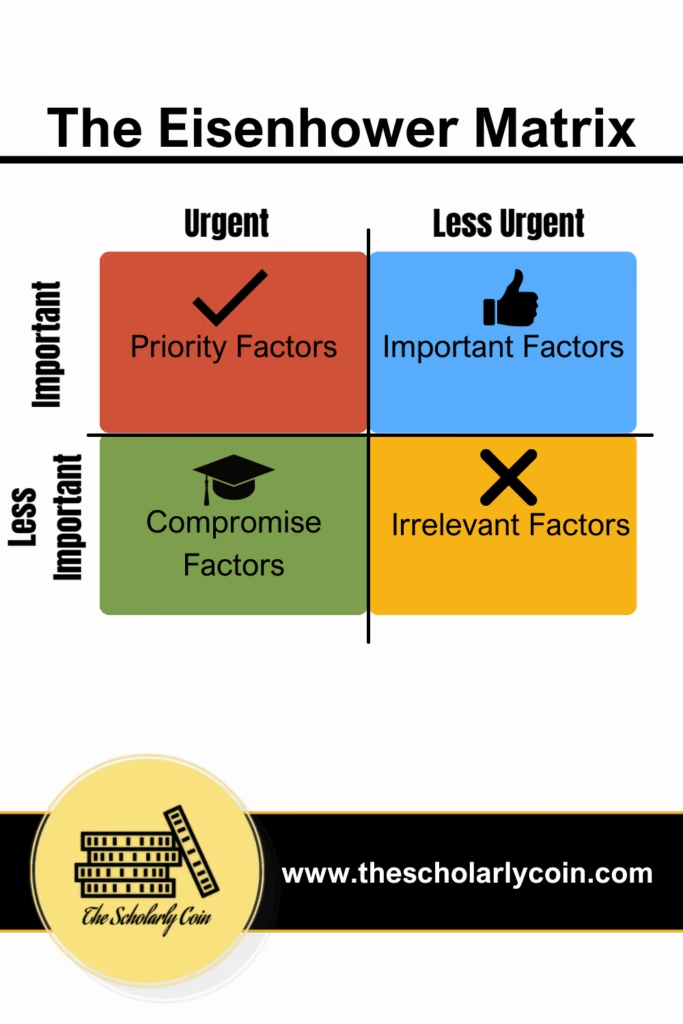
The Eisenhower Matrix is one of the simplest and most effective ways to make decisions fast and effectively. The Eisenhower Matrix is a graph with an x-axis and y-axis that evaluates decisions on a scale by urgency and importance. The image below breaks down how simple the Eisenhower Matrix is.
While the Eisenhower Matrix is primarily for productivity and tasks, it can be adapted to help us make better decisions. As you can see in the image, if a factor is both urgent and important it should be prioritized. If it’s important but not urgent, it should still take priority over less important things.
Think of high importance things as the factors that matter you to the most, and urgency as how quickly you want those things. For example, if you are deciding where to go to school, important factors might be location, school ranking, programs, campus life, sports opportunities, and size of the city.
Maybe location is important because you want to be near family, but it’s not urgent because you can be closer to family after college. However, you plan to only get your undergrad, so school ranking is both important and urgent (you aren’t planning on going back to school; it’s now or never). Lastly, maybe sports opportunities don’t really matter to you, and they aren’t urgent. You can remove those issues from the equation.
The Eisenhower Matrix really shines when it comes to time management and task prioritization, which we won’t get into here but, you can read an extensive article here about that.
Practical Advice on How to Make a Decision Quickly
While decision-making tools are nice in theory are they really practical? Yes, decision making tools can be very practical, but they can often be time consuming. If you’re short on time and can’t do a fast analysis, these are the things The Scholarly Coin recommends for making good decisions quickly.
- Know what is important (your values, your preferences, and your aptitudes).
- Focus on what you know, not what you don’t (there are unlimited variables that you can’t see. Focus on what you can be sure of).
- Keep a long-term focus (think about the future of the decisions you are making today).
- Be confident and be committed (confidence carries you a long way and commitment carries you the rest).
With these four decision-making focuses at the forefront of your brain you can easily make decisions quickly. Still struggling to see how to make a decision this way? Here is an example.
Decision-Making with an Example
Let’s say you have two job offers and you need to decide which one you are going to take by the end of the day. You don’t have enough time to sit down and draw up a graph or do a pros and cons list, so instead, you focus on the four things mentioned above. Your values, what you do know, your long-term focus, and commitment are all you need to have.
One job offers you a lot of money and good benefits, but the culture is a little rough and they make you work long hours. On top of that, career growth is often halted unless you are deemed part of the in group. However, if you strike it well with the company you could be making multiple 6-figures in a matter of years, and your wealth is in your future.
The second job offers you decent pay, decent benefits, a solid supportive culture, a focus on family and free time. This is a smaller company and less growth opportunities, but you’ve interview with the CEO, and he tells you that the executive team wants to step down in the next 5-7 years.
Psychologically, we have already made our decision. Before you finished reading the second job offer you already had an idea of what you wanted to do. This is called subconscious decision-making. Subconscious decision-making happens all the time, whether we are aware of it or not.
Making Decision Making Conscious
While our subconscious is typically a great decision maker, capable of making decisions quickly by process of highly efficient mental models, it can still make mistakes. In fact, most biased decisions are first made in the subconscious.
That is why it becomes increasingly important to make our decisions conscious. This way we can evaluate any biases and make better decisions. For the example above, we may value culture more than money. If that is the case the decision becomes much easier. Say no to toxic work environments and say yes to the things that matter to you.
The first job offer might make sense to some, just as the second job offer will make more sense to others. Be willing to commit to your decision by focusing on the long-term goal of your decisions.
I started this blog with the goal of reaching thousands of students to help them secure a brighter financial future. At the time of writing this I have just two email subscribers and less than 1,000 page views per month, but I have faith. I remember the long-term goal, and I am committed.
If you’re interested in supporting that goal, please subscribe to the newsletter and share this post on social media or with a friend.
How to Make a Decision by Putting it All Together
At this point you know how to make a decision. It boils down to the art of saying no, using the right decision-making tools (like the Eisenhower Matrix), and focusing on the things that are important for you.
If you got value from this article, you can boost your financial literacy by signing up to The Coin Newsletter here. If you have any questions, you can contact us directly here.
Now don’t just sit there. You know how to make a decision. Go out and make great decisions so that you can have a great life.
Until the next article.
**Hi, I am your author Ryan Lisota, and I am on a journey to educate students of all ages. I am young, just like you and I have a goal to be on Forbes 30 before 30. Help me make that dream come true by reading another article here or subscribing to my newsletter here.**
Thank you!